Assam: PM Modi Launches Namrup Fertilizer Project in Namrup
At Namrup in Dibrugarh, Prime Minister Narendra Modi lays the foundation of a large Ammonia–Urea fertilizer plant, promising support for farmers, jobs for youth and a stronger role for Assam in India’s development.
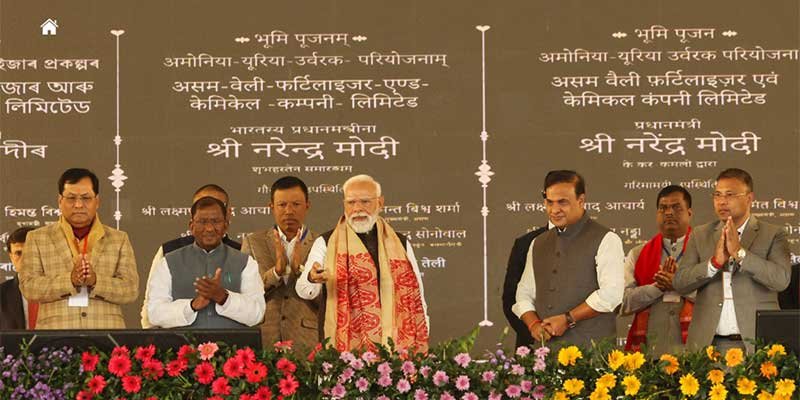
GUWAHATI- Prime Minister Narendra Modi on Sunday laid the foundation stone of a major Ammonia–Urea Fertilizer Project at Namrup in Dibrugarh district of Assam, describing it as a long-awaited step for Assam and the entire Northeast.

The brownfield project, to be built within the premises of Brahmaputra Valley Fertilizer Corporation Limited (BVFCL), is projected to invest over ₹10,600–11,000 crore and produce more than 12 lakh metric tonnes of fertilizer annually, aimed at meeting the needs of Assam and neighbouring states while reducing import dependence and logistics costs.
Addressing a public gathering, Modi termed the day “historic” and paid tribute to Assamese icons such as Chaolung Sukhapa, Lachit Borphukan, Bhupen Hazarika and others, saying he “bows to the sacred soil of Ujani Assam, this great land of valour and sacrifice.”
Also Read- PM Modi Calls Guwahati Airport a Symbol of Assam’s Progress


Framing the Namrup unit as part of a broader push for fertilizer self-reliance, Modi said farmers and “annadatas” are central to the government’s development strategy. He pointed out that India’s urea production has risen from about 225 lakh metric tonnes in 2014 to nearly 306 lakh metric tonnes today, against a requirement of roughly 380 lakh metric tonnes, and highlighted new and revived plants in Gorakhpur, Sindri, Barauni and Ramagundam alongside private investments.
The Prime Minister stressed that although urea is often imported at high international prices, farmers are shielded from this burden: a bag that costs the government around ₹3,000 is supplied to farmers at about ₹300, with the difference covered through subsidies.
Also Read- Modi’s ‘A for Assam’: From Vision to Delivery- By Sarbananda Sonowal
Modi said the Namrup plant would create thousands of direct and indirect jobs by generating permanent posts as well as work in repair, supply and associated services.
He argued that earlier governments had allowed older units at Namrup and other sites to languish, leading to closures and distress for farmers who once relied on the plant’s output, and contrasted this with the current administration’s efforts to revive and expand fertilizer capacity.
Also Read- AIIMS Guwahati Becomes First ATLS Centre in Northeast
The new unit’s output, he added, will reach fields not only in Assam but also in Bihar, Jharkhand, West Bengal and eastern Uttar Pradesh, making it a significant eastern pillar of India’s fertilizer supply chain.
The Prime Minister also linked the project to a series of welfare measures for farmers. He said that around ₹4 lakh crore has been transferred so far directly to farmers’ accounts under the PM-Kisan Samman Nidhi scheme, reducing their dependence on informal credit.
He cited the launch of PM Dhan Dhanya Krishi Yojana and the Dalhan Atmanirbharta Mission this year, along with crop insurance, improved procurement and expanded Kisan Credit Card coverage to livestock and fish farmers, as evidence that the government is working “from seed to market” to strengthen agriculture.
Modi further mentioned support for natural farming under a national mission, the creation of about 10,000 Farmer Producer Organisations and a dedicated oil palm mission for the Northeast to boost incomes and reduce edible oil imports.
Highlighting the presence and concerns of tea garden workers in Assam, Modi said about 7.5 lakh workers in the sector now have Jan Dhan bank accounts, enabling direct benefit transfers, and that schools, roads, electricity, drinking water and hospital facilities in tea areas are being upgraded.
He claimed that, guided by the “Sabka Saath, Sabka Vikas” vision, 25 crore people have exited poverty over the past 11 years, with a “neo-middle class” emerging in villages, evidenced by rising ownership of two-wheelers, cars, refrigerators, televisions and mobile phones.
The Prime Minister also used the occasion to criticise the opposition, accusing earlier governments of neglecting fertilizer plants, practising vote-bank politics and ignoring Assam’s identity and interests. In contrast, he said, the current government has highlighted symbols of Assamese pride, such as building a 125-foot statue of Lachit Borphukan and promoting the gamosa and Assam’s tea on national and international platforms—including gifting Assam black tea to Russian President Vladimir Putin during his visit to Delhi.
He argued that Eastern India and the Northeast would act as a “growth engine” for a developed India, and described the Namrup project as proof that the region is poised to become a major centre of self-reliant India and an “Ashtalakshmi” region in the country’s development story.