Thousands of Tangkhul Nagas Rally in Ukhrul and Kamjong, Demand Assam Rifles Withdrawal
Simultaneous rallies organised by Tangkhul Naga organisations called for the withdrawal of Assam Rifles from Naga areas, an end to the alleged “proxy war” and a permanent political solution to Manipur’s prolonged crisis.
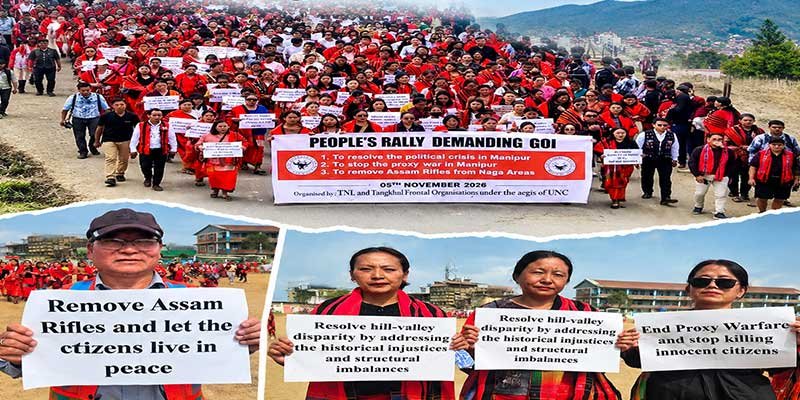
UKHRUL/KAMJONG- Thousands of people, including large numbers of women in traditional attire, took part in simultaneous massive “People’s Rallies” in the district headquarters of Ukhrul and Kamjong in Manipur on Thursday. Organised by the Tangkhul Naga Long (TNL) and Tangkhul frontal organisations under the aegis of the United Naga Council (UNC), the protests demanded the withdrawal of Assam Rifles from Naga-inhabited areas, an end to the alleged “proxy war” in Manipur, a permanent political solution to the state’s prolonged crisis, identification and deportation of illegal immigrants, and related measures.

In Ukhrul, participants assembled at locations including Dungrei Junction (Hungpung) and Mission Ground (Alungtang) before marching to Ukhrul Headquarters Ground for a public meeting. A parallel rally was held in Kamjong, starting from points such as the Police Gate and Kamjong High School Gate and culminating at Awontang Traffic Point. Shops, educational institutions and public transport remained closed in support, and protesters carried banners and placards with slogans including “Assam Rifles Quit Our Land,” “Stop Proxy War in Manipur,” etc.
Also Read- Massive Rally in Imphal Demands SoO Abrogation, Safe Return of Displaced Families
The three core demands highlighted on the main banners were: resolution of the political crisis in Manipur, stopping the proxy war in the state, and removal of Assam Rifles from Naga areas. Additional points in an 11-point memorandum submitted to Prime Minister Narendra Modi (with a copy to Union Home Minister Amit Shah) through the respective district administrations included restructuring of legislative representation between the hills and valley, rejection of any separate homeland or administrative arrangement for Kukis affecting Naga ancestral territories, revocation of the Suspension of Operations (SoO) agreements with Kuki armed groups, disarming and action against SoO cadres, relocation of internally displaced persons away from Naga areas, and cancellation of allegedly illegal settlement permits.


Also Read- Two Suspected Missing Kuki Villagers Found Dead During Joint Security Operation in Manipur
TNL president Sword Vashum addressed the gathering and media, calling on the Tangkhul community to unite and stand up for its rights, dignity and identity rather than depend on others for protection. He criticised the state government’s failure to ensure security along the Imphal–Ukhrul highway, noting a recent incident of suspected militants firing on passenger vehicles, and questioned how authorities could not guarantee safe movement even over a short stretch of about five kilometres.
Social activist Ngachonmi Chamroy described the Manipur situation as fundamentally a political crisis rather than merely a law-and-order problem, asserting that lasting peace would require genuine political will from the Government of India, and questioned the role and conduct of Assam Rifles.
Also Read- Two Kuki-Zo Youths Missing in Manipur’s Kangpokpi; CoTU Calls 48-Hour Shutdown
The rallies came against the backdrop of ongoing ethnic tensions in Manipur, including recent violence between Kuki and Naga communities in several hill districts since earlier in the year, and followed earlier calls related to the SoO pact and security force deployment. Organisers emphasised democratic, independent demonstrations by the Naga community.
As of the latest reports, the memorandums were submitted through district administrations for forwarding to the Centre. No immediate public statements from Assam Rifles, the Manipur state government or central officials specifically responding to Thursday’s rallies were available. The protests underscore continuing demands for political intervention amid the state’s complex security and ethnic challenges.