
Giant Traditional Guns Draw Attention at Hornbill Festival
The Konyak community of Mon district has preserved a distinctive tradition of handmade muzzle-loading firearms, with village artisans continuing to pass down specialised woodworking and metalworking skills.
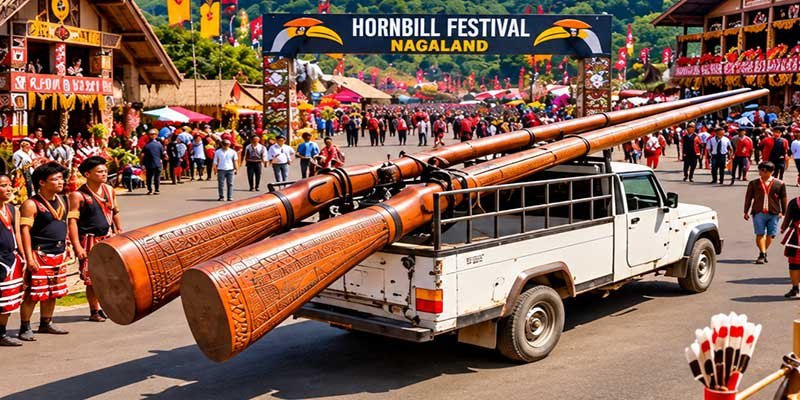
KOHIMA: Huge traditional guns being transported on a pickup truck at Nagaland’s Hornbill Festival Ground have drawn attention to the distinctive gunsmithing heritage of the Konyak Naga community, highlighting a traditional craft that has survived through generations.

Beyond their unusual size and appearance, these handmade muzzle-loading firearms represent a specialised tradition of metalworking and woodworking practised by village artisans in Mon district of eastern Nagaland.
The Konyak Nagas have a longstanding tradition of manufacturing traditional firearms, with specialised skills passed down through families. Village blacksmiths have historically worked with wood and metal to produce different components, preserving techniques through practical knowledge and training within their communities.
Also Read- Sikkim Cherry Festival to Become Annual State-Level Event from 2027

A Traditional Craft Passed Down Through Generations
Gunsmithing is among the distinctive traditional metalworking skills associated with the Konyak community. Apart from firearms, Konyak artisans have also traditionally manufactured agricultural implements, knives, machetes and other metal tools used in everyday life.
The craftsmanship has received public attention through demonstrations at the Hornbill Festival’s Craftscape exhibition, where visitors have been able to observe traditional techniques and learn about the community’s indigenous knowledge.
In 2024, two experienced gunsmiths, K. Moba and Nyeiba, from Changlangshu village in Mon district, demonstrated their traditional craft at Kisama. Reports at the time highlighted their efforts to train younger generations and preserve the specialised knowledge associated with gunsmithing.
Although the exact historical origins of Konyak gunsmithing remain unclear, the practice continues to represent an important aspect of the community’s traditional craftsmanship.
Also Read- Ropeway Project Row: Tourism Minister Invites Stakeholders for Site Inspection
Hornbill Festival: A Showcase of Nagaland’s Cultural Diversity
Held annually at Kisama Heritage Village, around 12 kilometres from Kohima, the Hornbill Festival brings together Nagaland’s diverse tribal communities to showcase their cultural traditions, music, dances, indigenous games, handlooms, handicrafts and local cuisine.
The festival has developed into an important platform for promoting the state’s cultural heritage and providing visibility to traditional artisans and their skills.
The 2026 edition is scheduled from December 1 to 10.
Also Read- Mizoram Students’ Union President Hospitalised During Hunger Strike Demanding MPSC Chief Resignation
Keeping Indigenous Knowledge Alive
The Konyak gunsmithing tradition offers an example of how indigenous knowledge continues to survive through generations of artisans and community participation.
At a time when traditional craftsmanship faces challenges from changing lifestyles and modern manufacturing, demonstrations and cultural platforms such as the Hornbill Festival provide opportunities to recognise these skills and encourage younger generations to learn them.
The preservation of such traditions is not merely about displaying historical objects. It is also about recognising the people, knowledge and craftsmanship that keep indigenous cultural practices alive.
Nagaland’s Konyak gunsmiths therefore represent another fascinating dimension of India’s cultural diversity, making the Hornbill Festival much more than a celebration of performances and festivities.