China’s COMAC Completes First Crewed Flight of Electric Commercial Aircraft CE-25A
China’s Commercial Aircraft Corporation of China (COMAC) successfully completed the first crewed flight of its CE-25A all-electric commercial aircraft on Saturday
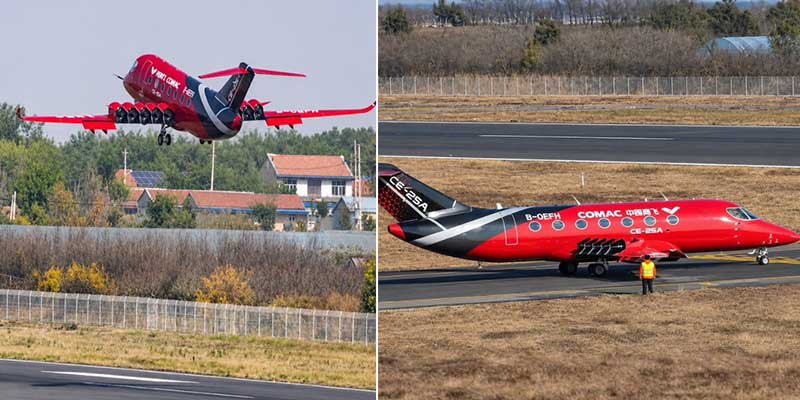
China’s Commercial Aircraft Corporation of China (COMAC) successfully completed the first crewed flight of its CE-25A all-electric commercial aircraft on Saturday, marking a significant milestone in the country’s push toward green aviation and battery-powered regional air travel.

The roughly 10-tonne demonstrator aircraft, designed to carry up to 19 passengers, took off and landed in Binzhou with two pilots and one flight-test engineer on board. The entire test, including ground operations, lasted 57 minutes and 46 seconds, of which the aircraft was airborne for 16 minutes and 38 seconds, covering approximately 60.4 kilometers. COMAC stated that the aircraft “operated normally” and that “all performance indicators met expectations.”
The CE-25A is powered by a distributed propulsion system of 10 electric ducted fans mounted along the wings (five on each side). Design targets include a cruise speed of 300 km/h, a cruise altitude of about 2,400 meters, and a range of around 400 km, aimed primarily at short inter-city commercial routes. The aircraft is being developed under China’s CCAR-25 transport-category airworthiness rules (broadly equivalent to Western Part 25 standards).
Also Read- A bizarre village in India where bats are worshipped


This was not the aircraft’s first flight. It had already completed 19 uncrewed autonomous test flights since its maiden unmanned intelligent flight on February 2, 2026. The Civil Aviation Administration of China (CAAC) has accepted COMAC’s application for a type certificate, formally beginning the airworthiness review process.
The program is a joint effort involving COMAC, battery giant Contemporary Amperex Technology Co. Limited (CATL), Shanghai Jiao Tong University, and other partners. The companies formed a joint venture in 2023 focused on electric aircraft development. Specific battery capacity, weight, chemistry, and energy density details for the CE-25A have not been publicly disclosed by COMAC or CATL.
Official Statements
COMAC emphasized the smooth performance of the flight and the progress toward certification. State media reports quoted the company confirming that the aircraft met all test expectations. The acceptance of the type-certificate application by the CAAC was highlighted as an important procedural step, though it does not authorize commercial passenger operations or set a timeline for service entry.
Also Read- Village “Piplantri” Where 111 Trees are Planted on the Birth of Girl Child
Reactions and Expert Commentary
Aviation observers and analysts have described the flight as a notable technical achievement for a 10-tonne-class battery-electric aircraft built to transport-category rules. Many view it as evidence of China’s integrated approach, leveraging its strengths in battery technology and state-backed industrial coordination.
However, several experts have struck a cautious note. Analysts point out that the 60 km crewed flight, while successful, represents only a fraction of the claimed 400 km design range and was conducted without a full passenger load. Questions remain about practical range once regulatory reserves, payload, and battery degradation are factored in. Some estimate that real-world operational range could be considerably shorter depending on the actual battery pack performance. Battery energy density, thermal management, fire safety, and charging times are seen as critical unknowns that certification authorities will scrutinize closely.
Western industry observers have noted the development with interest. Airbus executives have previously stated that they take Chinese competition seriously, particularly when programs are backed by national planning priorities. Commentators generally agree that the CE-25A does not currently challenge larger conventional airliners on medium- or long-haul routes but could influence the emerging market for short-haul electric regional aircraft.
Public and online reactions in China have been largely positive, framing the flight as another demonstration of technological progress in new-energy aviation, consistent with broader national goals of reducing carbon emissions in transportation.
Future Strategy and Outlook
COMAC has positioned the CE-25A as the first in a potential family of new-energy aircraft. Officials and state media have indicated ambitions to develop larger or longer-range electric or hybrid variants in the future, as well as possible specialized versions for business, rescue, or cargo roles. The near-term focus remains on completing the certification process for short inter-city operations.
The CE-25A program forms part of China’s wider strategy to advance green aviation technologies, reduce reliance on traditional fossil-fuel propulsion for regional routes, and build domestic capabilities in electric aircraft systems. Success could strengthen China’s position in the emerging global market for sustainable short-haul air transport, while also providing technological spillover benefits to other sectors.
While the first crewed flight represents an important step, the path from successful demonstration to certified commercial service remains substantial. Industry attention will now focus on subsequent test campaigns, publication of more detailed battery and performance data, and progress through the CAAC certification process.