
Meghalaya’s Wangala Festival Enters Guinness World Records with 1,000 Drums
More than 1,000 traditional Dama drummers, along with hundreds of dancers and performers, created history at the Golden Jubilee celebrations of the Hundred Drums Wangala Festival in West Garo Hills.
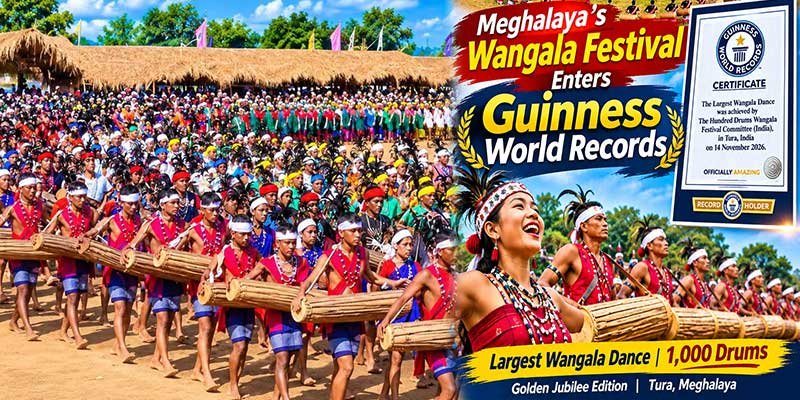
TURA/CHIBRAGRE: Meghalaya’s iconic Hundred Drums Wangala Festival has entered the Guinness World Records after creating history with the Largest Wangala Dance during its Golden Jubilee celebrations in West Garo Hills.

More than 1,000 traditional Dama drummers performed in synchronised rhythm alongside hundreds of women dancers and warriors during the special record attempt at Wangala A’dam, Garo Heritage Village in Chibragre, near Tura.
The historic achievement came during the four-day 50th anniversary celebrations of the festival, held from November 11 to 14, marking a major moment of international recognition for the cultural heritage of the Garo, or A’chik, people.
Also Read- Golden Jubilee of 1000 Drums Wangala Festival Opens in Meghalaya


‘Rhythm of 1,000 Drums’ Creates History
The record attempt, described as the “Rhythm of 1,000 Drums,” brought together performers and cultural groups from across the Garo Hills.
Guinness World Records adjudicator Richard Williams Stenning from the United Kingdom announced the achievement at approximately 3:50 pm following the special performance.
The announcement triggered celebrations among thousands of participants and visitors gathered at the venue as the Guinness World Records certificate was presented.
The achievement represents a remarkable transformation for the Wangala Festival—from a traditional indigenous harvest thanksgiving celebration into a globally recognised cultural event.
Also Read- Tensions Flare Outside Meghalaya Secretariat Over Shillong Ropeway Project
Chief Minister Calls It a Proud Moment
Meghalaya Chief Minister Conrad K. Sangma described the Guinness World Records recognition as a proud moment for the Garo people.
The Chief Minister said the Golden Jubilee was an appropriate occasion to celebrate the festival on a much larger scale and realise the vision of expanding the traditional Hundred Drums format to 1,000 drums.
According to Sangma, the milestone also fulfilled a vision associated with his late father, former Lok Sabha Speaker and National People’s Party founder P.A. Sangma, who had envisaged an expanded celebration featuring 1,000 drums during the festival’s Golden Jubilee.
The Chief Minister emphasised the importance of preserving cultural identity and supporting indigenous traditions for future generations.
Also Read- Meghalaya Govt Refuses to Scrap Rs 151-Crore Shillong Peak Ropeway Project
From a Traditional Festival to Global Recognition
The Wangala Festival is the traditional post-harvest thanksgiving celebration of the Garo people.
Dedicated to Misi Saljong, or Saljong, regarded in Garo tradition as the sun deity associated with fertility, the festival marks the completion of agricultural work and the arrival of the winter season.
Traditional celebrations feature rituals, folk songs, dances, warriors in ceremonial attire and the distinctive long oval wooden drums known as Dama.
The organised Hundred Drums format began in 1976, at a time when concerns were being raised about the gradual decline of traditional drum performances.
What began with a relatively small group of Dama players eventually developed into the Hundred Drums Wangala Festival, with large contingents of drummers and dancers performing together.
Over five decades, the festival has grown into one of Northeast India’s most significant indigenous cultural events.
Also Read- Shillong Turns White After Heavy Hailstorm, Creating Rare Snow-Like Scene
Golden Jubilee Marks a New Milestone
The 50th anniversary celebrations took the festival to an unprecedented scale.
The participation of 1,000 drummers and hundreds of dancers represented a major expansion from the original Hundred Drums format and brought international recognition to the festival.
The Meghalaya government supported the Golden Jubilee event with funding for the development of the Wangala A’dam venue and the organisation of the celebrations, including arrangements connected with the Guinness World Records attempt.
Village contingents from across the Garo Hills also participated in the celebrations, reflecting the broad community involvement behind the event.
A dance competition held alongside the celebrations saw Chidaogre secure first prize, followed by Gondenggre as first runner-up and Sadolbra as second runner-up.
A Boost for Garo Heritage and Cultural Tourism
The Guinness World Records recognition is expected to further strengthen the visibility of Garo culture at the national and international levels.
Beyond the record itself, the achievement highlights the role of cultural festivals in preserving indigenous traditions, music, dance and community identity.
The event also carries potential significance for tourism, with Wangala now gaining greater global visibility as one of Northeast India’s major indigenous cultural showcases.
From its beginnings as a traditional harvest thanksgiving celebration to the historic performance of 1,000 drums on its Golden Jubilee, the Wangala Festival has completed a remarkable journey.
The Guinness World Records recognition now stands as a major milestone in that journey—celebrating not only a record-breaking performance, but also the resilience, preservation and continuing evolution of Garo cultural heritage.