
Historic Stock Market Bloodbath Rocks Dalal Street: Sensex Plunges 2,497 Points, ₹12 Lakh Crore Wiped Out
Indian markets plunge sharply as geopolitical tensions, oil price surge, and banking sector shocks trigger massive sell-off.
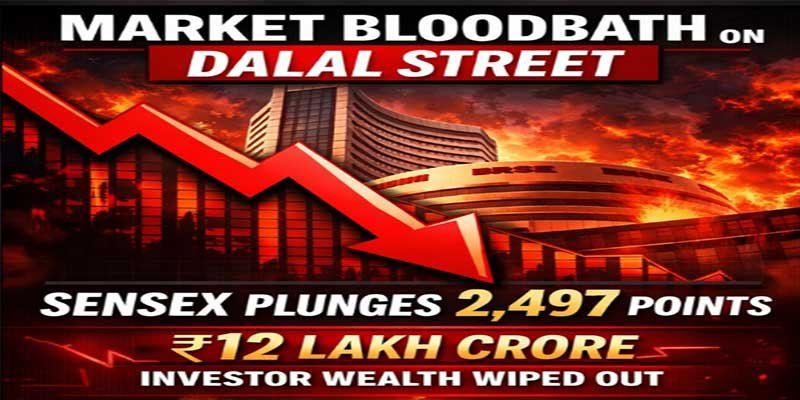
MUMBAI — Indian equity markets suffered one of their most severe single-day crashes in recent history on Thursday, as escalating geopolitical tensions in the Middle East, surging crude oil prices, and domestic banking sector shocks triggered widespread panic selling.

The BSE Sensex tumbled 2,497 points (3.26%) to close at 74,207.24, while the NSE Nifty 50 plunged 776 points (3.26%) to settle at 23,002.15. This marked the benchmarks’ worst performance since June 2024 and erased gains from the previous three trading sessions.
Investor wealth evaporated dramatically, with the BSE’s total market capitalization shedding over ₹12 lakh crore (some estimates put the figure as high as ₹13-14 lakh crore), dropping from around ₹439 lakh crore to approximately ₹427 lakh crore.
Intraday lows were even steeper: the Sensex hit 73,950.95 (down 2,753 points), and the Nifty dipped to 22,930.35 (down 847 points).


Also Read- CBI Questions Anil Ambani in ₹2,929 Cr Case
Primary Triggers Behind the Carnage
The sell-off was fueled by a perfect storm of global and local factors:
Geopolitical Escalation in the Middle East: Ongoing US-Israel-Iran conflict intensified with Iranian strikes on key energy infrastructure, including Qatar’s Ras Laffan LNG hub (the world’s largest) and facilities in Saudi Arabia and Kuwait.
This disrupted supplies through the Strait of Hormuz, a chokepoint for ~20% of global oil and LNG. Brent crude surged sharply, briefly topping $119 per barrel before settling around $111-116, amplifying fears of prolonged energy shortages and inflation for oil-import-dependent India.
Oil Price Shock and Inflation Fears: The spike in crude (up ~8-10% in recent sessions) hit Indian importers hard, raising concerns over higher fuel costs, widening trade deficits, and corporate margin pressure. Sectors like autos (-4.3%), financials (-3.8%), and realty (-3.8%) bore the brunt.
Also Read- Security Scare at Washington after Unidentified Drones Detected Over US Military Base
HDFC Bank Shock: The heavyweight lender’s shares crashed amid the abrupt resignation of its chairman, citing “ethical concerns,” dragging banking and financial indices lower and contributing significantly to the overall decline.
Global and Macro Pressures: A hawkish US Federal Reserve stance (rates held steady with no immediate cuts signaled) combined with massive FII outflows (ongoing since the conflict began) and rupee weakness (nearing 93/USD) fueled risk-off sentiment worldwide.
All major sectors ended in the red, with midcap and smallcap indices falling ~3% each. India VIX (volatility gauge) spiked over 21%, reflecting extreme fear in the market.
Broader Context and Investor Impact
This crash comes amid a turbulent period since late February, when the US-Israel-Iran war escalated, already wiping out tens of lakh crores in cumulative market value. Today’s rout reversed recent recoveries and pushed benchmarks to multi-month lows, with the Sensex at its weakest since April 2025.Social media erupted with terms like “bloodbath on Dalal Street,” as traders shared red-screen screenshots and memes. Many highlighted ironic contrasts, such as upstream oil firms (e.g., ONGC gaining modestly) amid the chaos.
Experts warn of continued volatility if Gulf disruptions persist, potentially pushing crude toward $150 in extreme scenarios. However, some see support near Nifty’s 22,800-23,000 zone for a possible relief bounce if global cues stabilize.
Markets remain on high alert, with Friday’s trade likely influenced by any fresh developments in the Strait of Hormuz, oil flows, and diplomatic efforts. Investors are advised to prioritize risk management amid this historic turmoil.