Assam Cabinet Greenlights Talks with Tribal Groups Amid Escalating ST Status Protests
The Assam Cabinet has approved high-level talks with tribal organisations after statewide protests erupted over recommendations to grant ST status to six OBC communities.
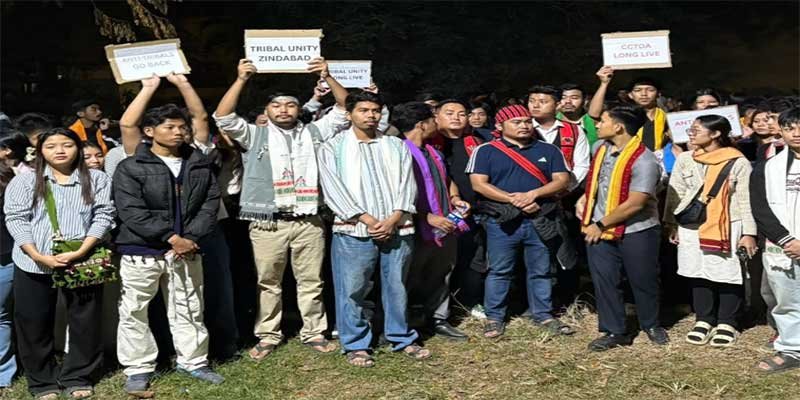
GUWAHATI- Amid intensifying protests across Assam over the proposal to grant Scheduled Tribe (ST) status to six OBC communities, the Assam Cabinet on Sunday evening approved high-level talks with tribal groups opposing the move. The decision comes after days of agitation, including widespread symbolic burnings of the Group of Ministers (GoM) report that was tabled in the Assembly on November 29.
The GoM report, submitted by Tribal Affairs (Plains) Minister Ranoj Pegu, recommends ST status for the Tai Ahom, Chutia, Moran, Matak, Koch-Rajbongshi, and Tea Tribes (Adivasis)—communities that together account for roughly 27% of the state’s population. It proposes a three-tier reservation model, separating ST (Hills), ST (Plains), and a newly created “ST (Valley)” category, aimed at safeguarding existing quotas while accommodating the six groups’ long-standing demands.
However, the proposal has been vehemently rejected by the Coordination Committee of Tribal Organizations of Assam (CCTOA), a coalition of 26 bodies representing 14 existing ST communities, including Bodo, Rabha, Mising and Dimasa groups. CCTOA chief coordinator Aditya Khakhlari argued that inclusion would “dilute and destabilize” existing reservations, both at state and national levels.
Also Read- Fresh Clash at Assam–Meghalaya Border in Pilingkata

“This is not sub-categorization; it’s an invasion of our hard-earned rights,” he said, warning of rail and highway blockades if the government proceeds.
Protests peaked on November 30, with CCTOA and allied groups such as ABSU burning copies of the report in Guwahati, Kokrajhar, Boko, and Goalpara.
In Kokrajhar, where tensions had been simmering for days, a student protest spiralled after hundreds stormed the Bodoland Territorial Council (BTC) Secretariat, damaging property and breaching barricades. Authorities subsequently imposed Section 144 in the district.
Also Read- Bodo’s Torchlight March Opposes Assam’s ST Decision
ABSU secretary Anjalu Boro said the proposal threatened safeguards under the 2020 Bodo Accord, adding that the recommendations could alter political representation in the Bodoland Territorial Region (BTR). “We are not against any community, but this will destroy our future,” he said.
Following a marathon Cabinet meeting, Chief Minister Himanta Biswa Sarma announced that the government would open formal dialogue with protesting organisations.
“We believe the report protects existing ST rights and paves the way for the six communities. Some groups have not read it properly. We welcome them for a detailed discussion,” Sarma said.
Also Read- Bodoland University Shut Over ST Row
Three ministers—Ranoj Pegu, Keshab Mahanta, and Pijush Hazarika—have been tasked with holding talks with CCTOA “at the earliest” to explain the “nuances and safeguards” in the recommendations. Sarma also criticised the opposition Congress for “politicising” the issue, urging them instead to submit written suggestions.
Congress leader Gaurav Gogoi maintained that his party supported the ST demand but insisted on “ironclad protection” for existing communities.
Meanwhile, celebrations were reported in Upper Assam districts such as Sivasagar and Dibrugarh, where supporters of the six communities marked the report’s tabling with traditional Bihu dances and fireworks.
The Assam Jatiya Parishad (AJP) questioned the government’s seriousness, with leader Lurinjyoti Gogoi demanding a clear implementation timeline.
As Assam moves toward the 2026 Assembly elections, the ST issue has become a focal point of political contestation, intersecting with ongoing eviction drives and debates over land, identity, and resource allocation. With CCTOA vowing “vigorous movements” unless the proposal is withdrawn, the outcome of the upcoming talks may prove crucial in preventing escalation.
A flag meeting between ministers and tribal groups is expected in the coming days, even as the Assembly resumes its winter session later this month.