
Arunachal: Anti-Dam Protests in Siang Escalate, MLA Alo Libang’s Residence Allegedly Vandalised
Protesters oppose the proposed Siang Upper Multipurpose Project and Pre-Feasibility Report survey, citing displacement, land, livelihood and environmental concerns.
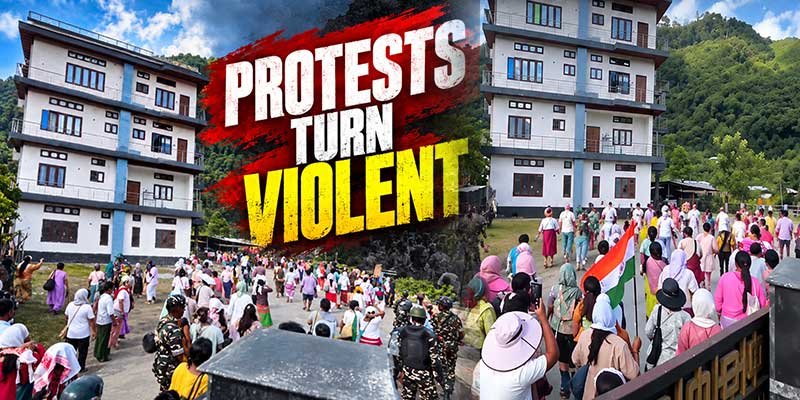
ITANAGAR: Protests against the proposed Siang Upper Multipurpose Project (SUMP) intensified in Arunachal Pradesh’s Upper Siang district on Wednesday, with demonstrators blocking roads, clashing with security personnel and allegedly vandalising the residence of Tuting-Yingkiong MLA Alo Libang in Yingkiong.

The escalation came amid opposition to the deployment of central paramilitary forces for a Pre-Feasibility Report (PFR) survey for the proposed hydropower project on the Siang river at Beging in East Siang district.
The protesters are demanding an immediate halt to the survey activities and withdrawal of security forces from areas that could be affected by the project. The agitation disrupted movement along the Yingkiong-Komkar-Geku road and towards Dite Dime, where protesters erected blockades at several locations.
Also Read- NIA Arrests Second Accused in Manipur’s Tronglaobi IED Attack


Tensions reportedly escalated when demonstrators entered the residence of MLA Alo Libang in Yingkiong and allegedly vandalised the premises while raising anti-dam slogans. Several government vehicles were also reportedly damaged. In a separate incident near Dite Dime, a police vehicle was set on fire.
Security personnel intervened at several locations, resulting in scuffles between protesters and security forces.
Watch Video-
The protests also affected the movement of senior state government leaders. Demonstrators reportedly restricted movement outside a hotel where Deputy Chief Minister Chowna Mein, ministers Ojing Tasing and Nyato Dukam, and Chief Minister’s Advisor Ninong Ering were staying.
However, Upper Siang Deputy Commissioner Ashok Tajo said Chief Minister Pema Khandu completed his scheduled official meeting in Yingkiong before leaving the district by helicopter.
Also Read- Darjeeling Himalayan Railway Gets Global Tourism Spotlight from Lonely Planet
The immediate trigger for the latest protests is the government’s decision to proceed with the PFR survey for SUMP, which has an estimated capacity of more than 10,000 MW. Opposition groups argue that the project could have significant consequences for communities living along the Siang river.
Sections of the indigenous Adi community and organisations opposing the project have raised concerns about possible displacement, loss of ancestral and customary land, livelihoods, cultural identity and environmental impacts.
The project is estimated to potentially affect around 100,000 residents, according to the concerns raised by those opposing it. Protesters have also continued to resist the movement of machinery towards proposed survey locations in Geku, Komkar and adjoining areas.
The latest unrest follows a confrontation at Geku on September 28, when villagers and security personnel clashed. Government vehicles were damaged during that confrontation, and four people were detained before subsequently being released.
Also Read- 60 Tourists Evacuated from Lachen After Five Days of Severe Weather
The Siang Indigenous Farmers’ Forum (SIFF), one of the organisations leading the opposition, had declined an invitation for talks during Chief Minister Khandu’s September 29-30 visit and sought direct dialogue with communities that could be affected by the project.
Khandu, meanwhile, has maintained that carrying out the PFR does not amount to approval for construction of the project. According to the chief minister, the survey is intended to determine the project’s technical feasibility and identify possible locations and technical parameters.
The PFR is expected to take around three months. Khandu has said that subsequent steps, including social and environmental impact assessments, preparation of a detailed project report and public consultations, would depend on the findings of the feasibility exercise.
Also Read- CJP Co-Convenor Ashutosh Ranka, Over 30 Workers Detained in Guwahati
The chief minister has also said that people have the democratic right to oppose the project and question government decisions, while stressing that protests should not result in the destruction of public or private property.
The state government has constituted an Empowered High-Level Committee, headed by Rural Development and Panchayati Raj Minister Ojing Tasing, to coordinate and oversee the PFR process.
The dispute over the Siang project also comes against a wider regional backdrop of concerns over large hydropower developments in the transboundary river system. In December 2024, China approved construction of a major hydropower project on the lower reaches of the Yarlung Tsangpo, known as the Brahmaputra after it enters India.
The continuing protests in Arunachal Pradesh therefore involve both local concerns over land, displacement, livelihoods and ecology and wider questions surrounding the development and management of the Siang river basin.
For now, the immediate issue remains the PFR survey. While the government maintains that the exercise is only a technical feasibility assessment and does not itself constitute approval for construction, opposition groups are demanding that survey activities be stopped and that affected communities be directly consulted before any further steps are taken.