Assam Elephant Mangal Singh Undergoes Critical Dental Procedure After Poachers Hack Off Tusks
A joint veterinary team performed a specialised partial pulpotomy on 16-year-old Mangal Singh after both tusks were hacked off near the roots in an April poaching attack.
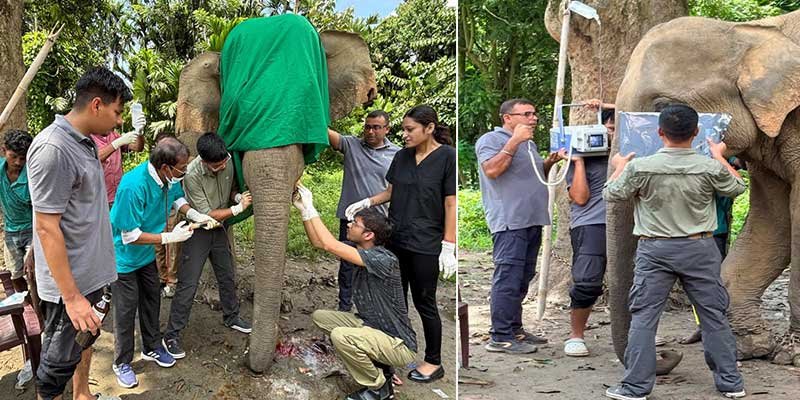
MARGHERITA ( Assam )- A 16-year-old captive elephant named Mangal Singh has undergone a specialised dental procedure in Margherita, Assam, months after poachers allegedly hacked off both his tusks near the roots, leaving the animal with exposed pulp cavities and a continuing risk of severe infection.

The procedure, conducted on August 26, was a partial pulpotomy, performed by a joint veterinary team led by Dr Bhaskar Choudhury of the Wildlife Trust of India (WTI). The intervention was undertaken after the elephant continued to suffer from complications caused by the tusk injuries sustained in April.
Tusks hacked off near roots
The attack reportedly took place in April 2026 in the Dhulijan forest area of Lakhipathar, Digboi. According to the release, both tusks were hacked off near their roots, leaving the pulp cavities exposed.
Mangal Singh is privately owned in Margherita. His cries following the attack alerted local residents, who informed the Digboi Forest Department. Government veterinary teams subsequently responded and began emergency treatment.

Also Read- Centre Approves ₹5,000 Crore PMAY Housing Package for Flood-Affected Assam
Veterinary Surgeon Dr Mehedi Hassan of WTI said the elephant had initially remained in critical condition with severe bleeding. Because the tusks had been cut close to their roots, the exposed pulp cavities continued to create a risk of infection despite regular monitoring and treatment.
Elephant kept in familiar surroundings
The Centre for Wildlife Rehabilitation and Conservation (CWRC) team decided to keep Mangal Singh in his familiar surroundings rather than transport him to an unfamiliar location.
According to the release, the decision was based on concerns that transportation and unfamiliar surroundings could cause additional stress to the captive-born elephant, which has strong social bonds with the family and environment in which he grew up.
Also Read- Assam CM Himanta Biswa Sarma Meets PM Modi, Discusses Flood Recovery
With the animal continuing to suffer and the risk of infection remaining, veterinary experts determined that the exposed pulp cavities required closure through a specialised procedure.
Multidisciplinary team performs procedure
The partial pulpotomy was carried out by a multidisciplinary veterinary team on August 26 at Margherita.
The team included Dr Bhupen Sarma, retired professor of Surgery and Radiology and an expert in elephant anaesthesia; a specialised orthodontics team from Tinsukia led by Dr Abhishek Ojha; senior veterinarians from the Animal Husbandry Department, including Dr Rabi Shankar Choudhury and Dr Bishwajit Barua; and Dr Mehedi Hassan of WTI.
Also Read- Manipur: Large Cache of Weapons Seized in Kangpokpi and Imphal East
Rohini Kumar Das, DFO Digboi, said local veterinarians had continued treating the elephant over the previous months, but the exposed pulp cavities in both tusks required closure through partial pulpotomy.
He said the procedure had been successfully initiated and that the veterinary team would provide post-operative care for the next seven days.
Wildlife experts raise concern over elephant protection
Dr Bhaskar Choudhury described Mangal Singh’s condition as distressing and said the circumstances surrounding the loss of his tusks raised serious concerns about elephant protection, including elephants under private ownership.
He said the immediate priority was to ensure that Mangal Singh received the necessary treatment and care for recovery.
WTI CEO Jose Louies said the case highlights the severe physical and psychological consequences associated with illegal ivory-related activities. He also stressed the need for continued vigilance, stronger protection measures and swift action against wildlife criminals.
The Centre for Wildlife Rehabilitation and Conservation (CWRC) near Kaziranga National Park is jointly run by the Assam Forest Department, the Wildlife Trust of India and IFAW.
The latest intervention marks an important stage in Mangal Singh’s treatment, although the veterinary team will continue monitoring the elephant during the post-operative period.