Sikkim to Host First Himalayan Yak Festival in Gnathang Valley in October
The one-day festival in late October will bring together yak farmers and pastoral communities from across the Indian Himalayas to promote conservation, sustainable livelihoods and high-altitude tourism.
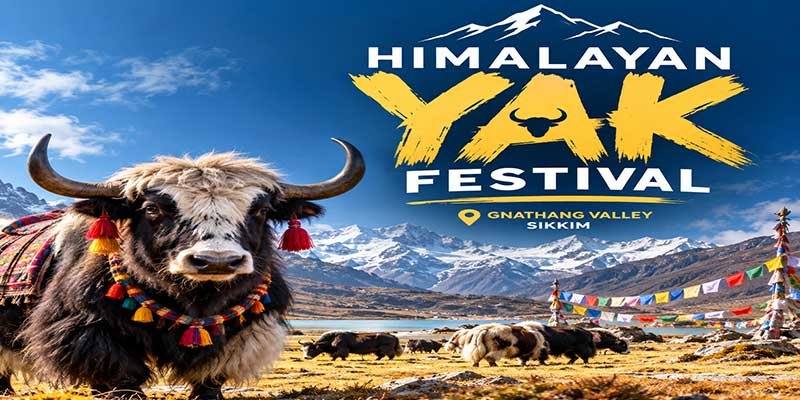
GANGTOK- Sikkim is set to host its inaugural Himalayan Yak Festival at the high-altitude Gnathang Valley in the last week of October 2026. The one-day event aims to bring together yak farmers and pastoral communities from across the Indian Himalayas to promote conservation, sustainable livelihoods, and high-altitude tourism.

Located at approximately 13,500 feet (about 4,100 metres) in East Sikkim’s Pakyong district along the historic Old Silk Route, Gnathang Valley (also known as Nathang Valley) has long been associated with traditional yak herding. The remote alpine pastureland, often called the “Ladakh of East Sikkim,” features expansive meadows used for seasonal grazing and lies near key passes that once facilitated trade between Sikkim and Tibet.
The festival will gather participants from Sikkim, Arunachal Pradesh, Himachal Pradesh, and Ladakh. Organisers plan to showcase different yak breeds, traditional herding practices, and local products derived from yaks. It will also serve as a platform for farmers to exchange knowledge and promote sustainable yak husbandry techniques.
Also Read- 60 Tourists Evacuated from Lachen After Five Days of Severe Weather


The initiative comes amid growing concerns over the declining yak population across India. According to ICAR research, Sikkim currently has around 5,219 yaks, reared primarily by the nomadic Dokpa (or Drokpa) pastoral community. Nationally, yaks are concentrated in the high Himalayas of Sikkim, Arunachal Pradesh, Himachal Pradesh, and Ladakh, with the overall Indian population estimated in recent years at around 58,000. The Sikkimese yak has been recognised as a distinct breed by the National Bureau of Animal Genetic Resources.
The festival seeks to raise awareness about conservation needs, the potential of scientific breeding methods, and the economic opportunities that yak farming can offer Himalayan communities. Yaks provide milk (used for products such as cheese and butter tea), meat, wool, and transport in extreme high-altitude environments, while also holding cultural and spiritual significance in local traditions.
Also Read- NIA Arrests Second Accused in Manipur’s Tronglaobi IED Attack
Gnathang Valley’s selection as the venue is significant. The area has a deep connection to yak pastoralism, and recent scientific efforts have focused there. In mid-2026, scientists from the ICAR-National Research Centre on Yak (NRCY) in Dirang successfully demonstrated Fixed-Time Artificial Insemination (FTAI) under field conditions in Gnathang, achieving a 56% conception rate among enrolled female yaks and resulting in the birth of healthy calves. Such interventions highlight ongoing attempts to improve genetic quality and reverse population declines through modern reproductive technologies adapted to traditional free-ranging systems.
High-altitude tourism is another key pillar of the festival. Gnathang’s dramatic landscapes, proximity to the Old Silk Route circuit (including sites near Zuluk and Kupup), and scenic alpine vistas already attract visitors seeking offbeat Himalayan experiences. The event is expected to further highlight the region’s potential while supporting local livelihoods linked to both herding and tourism.
Also Read- Anti-Dam Protests in Arunachal Escalate, MLA Alo Libang’s Residence Allegedly Vandalised
The Himalayan Yak Festival marks an important step in recognising the cultural, ecological, and economic value of yak pastoralism in the Eastern Himalayas. By uniting herders from multiple states and focusing on both tradition and science-based solutions, organisers hope the gathering will contribute to the long-term sustainability of this unique high-altitude livelihood system.
Further details on the exact date within the last week of October, the full programme schedule, and participation guidelines are expected to be released by the relevant state authorities in the coming weeks.