Manipur Crisis Enters Fourth Year Unresolved
Three years after violence erupted, Manipur continues to grapple with displacement, division, and fragile peace.
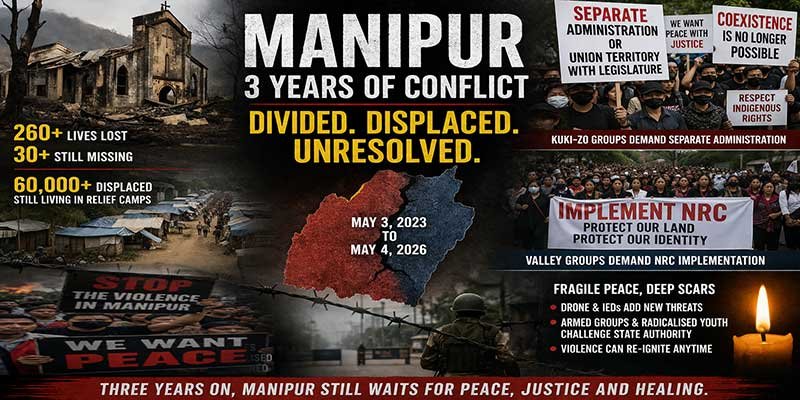
IMPHAL- Manipur marked three years of ethnic conflict on May 4, 2026, with rallies and shutdowns across both Meitei-dominated valley regions and Kuki-Zo inhabited hill districts, underscoring a state that remains deeply divided despite a relative decline in large-scale violence.

Since the outbreak of clashes on May 3, 2023, more than 260 people have lost their lives, while over 60,000 residents continue to remain displaced, many of them still living in relief camps. Officials and civil society groups estimate that more than 7,800 houses were destroyed, along with hundreds of religious structures, including churches and temples.
Families of over 30 individuals who went missing during the violence continue to seek clarity, facing administrative and legal hurdles in obtaining official documentation and government assistance.
Also Read- Protesters March to CM’s Bungalow, Clash with Forces; Dozens Injured


The conflict has effectively resulted in a demographic and administrative separation between the valley and hill regions, with limited movement across communities and continued security deployment along buffer zones.
Organisations representing Kuki-Zo communities, including Indigenous Tribal Leaders’ Forum and Kuki Inpi, have reiterated demands for a separate administrative arrangement or Union Territory with a legislature. They argue that the current situation has made coexistence difficult.
Also Read- Manipur Paralysed by Shutdowns, Protests, Candlelight Vigils
On the other hand, valley-based civil society groups under COCOMI have called for the implementation of the National Register of Citizens (NRC), citing concerns over demographic change and territorial integrity.
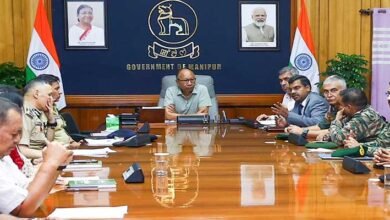
The political landscape has also seen significant shifts. Following a year under President’s Rule from February 2025 to February 2026, a new government led by Chief Minister Yumnam Khemchand Singh assumed office earlier this year. The government initiated its first round of peace talks with Kuki-Zo groups on May 1, 2026.
Also Read- Firing Near CM Event Leaves One Injured
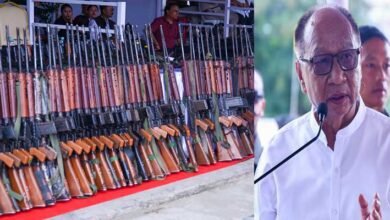
While large-scale clashes have reduced, the situation on the ground remains volatile. Security agencies have reported the use of drones and improvised explosive devices in sporadic incidents along sensitive areas. The presence of armed village defence groups and radicalised youth organisations continues to pose challenges to law enforcement.
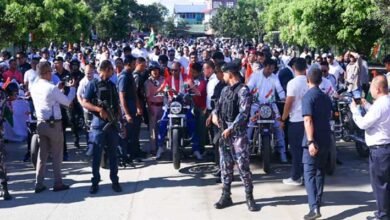
Recent incidents, including a bomb attack in Bishnupur district in April 2026 that resulted in the deaths of two children, triggered fresh protests and temporary internet shutdowns, highlighting the fragile nature of the current peace.
Observers note that although overt violence has declined, the underlying issues of identity, territory, and political representation remain unresolved, leaving the state in a prolonged phase of uncertainty.