Assam Assembly Passes Uniform Civil Code Bill 2026 Amid Opposition Protest
The Assam Assembly passed the Uniform Civil Code Bill 2026 by voice vote, introducing common civil laws on marriage, inheritance, divorce, and live-in relationships while exempting Scheduled Tribes and certain tribal areas.
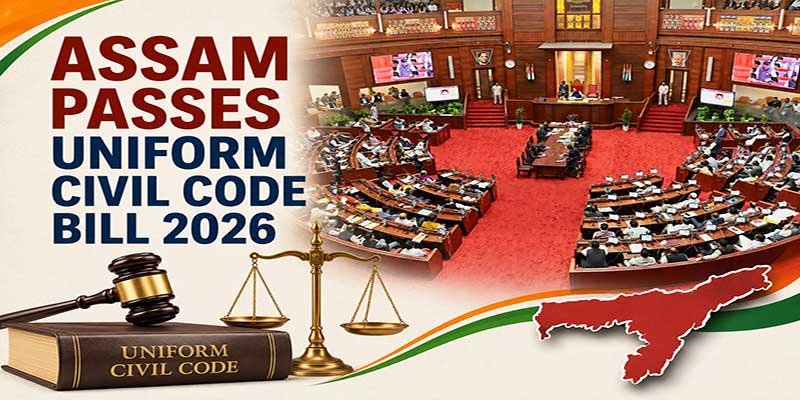
GUWAHATI- The Assam Legislative Assembly on Wednesday passed the Uniform Civil Code (UCC), Assam, Bill 2026 by voice vote, making Assam the third state in India, after Uttarakhand and Gujarat, to adopt a comprehensive common civil code aimed at replacing religion-specific personal laws for most residents.

The bill was introduced on May 25 by Parliamentary Affairs Minister Atul Bora on behalf of Chief Minister Himanta Biswa Sarma. It was passed during the concluding day of the first session of the 16th Assam Legislative Assembly following extensive discussions between treasury and opposition benches.
Speaker Ranjeet Kumar Dass announced the passage of the bill after members of the ruling coalition supported it and rejected opposition demands to refer the legislation to a select committee for wider consultation.
Also Read- Jio Offers 15 OTT Platforms, 1,000+ TV Channels in New ₹200 Plan


The legislation establishes uniform legal provisions governing marriage, divorce, inheritance, succession, adoption-related matters, and live-in relationships. According to the government, the bill aims to promote gender equality, legal uniformity, and social reform while balancing the state’s demographic and cultural diversity through specific exemptions.
Among the key provisions, the bill prohibits polygamy and declares marriages involving more than one spouse legally invalid. It also retains the legal minimum marriage age at 21 years for men and 18 years for women.
The legislation mandates registration of all marriages and requires live-in relationships to be officially registered. It includes provisions concerning legal rights of partners and children born out of such relationships, along with penalties for non-compliance.
Also Read- Senior ACS Officer Arrested in Assam Bribery Case; Assets Worth ₹1.3 Crore Seized
The bill further introduces equal inheritance rights for sons and daughters irrespective of religious identity, moving away from religion-based succession laws. Divorce proceedings under the proposed framework are to be handled primarily through courts, which the government says is intended to improve transparency and strengthen legal protection for women.
At the same time, Scheduled Tribes and certain notified tribal areas have been exempted from the purview of the code in recognition of customary practices and constitutional protections available to indigenous communities.
The bill also repeals the Assam Compulsory Registration of Muslim Marriages and Divorces Act, 2024, which the government said was necessary to establish a uniform statutory framework.
The ruling Bharatiya Janata Party and its allies described the legislation as a progressive measure aimed at ensuring equality and justice, particularly for women. Chief Minister Himanta Biswa Sarma has repeatedly projected implementation of the Uniform Civil Code as a major policy commitment aligned with the party’s electoral agenda.
Opposition parties, including the Indian National Congress, Raijor Dal, and All India United Democratic Front, strongly opposed the bill during the Assembly session. Opposition members argued that the legislation was introduced without adequate consultation with stakeholders and failed to sufficiently account for Assam’s religious and cultural diversity.
Other opposition leaders raised concerns that the legislation could deepen social and political divisions if implemented without wider consensus and consultation.
The passage of the bill comes amid increasing momentum for state-level Uniform Civil Code legislation across India. Assam is now the first state in the Northeast region to adopt such a legal framework.
The bill will now require assent from the President of India before it can be formally notified and implemented. Legal observers expect constitutional scrutiny and possible judicial challenges concerning questions related to religious freedom, equality, and federal structure.
The development is expected to significantly influence political discourse in Assam and the Northeast in the coming months, particularly in the context of debates surrounding personal laws, constitutional rights, and social reform.