Assam Government Tables Uniform Civil Code Bill in Assembly
The proposed legislation seeks to establish a unified civil legal framework governing marriage, divorce, succession, and live-in relationships while exempting tribal communities and Sixth Schedule areas.
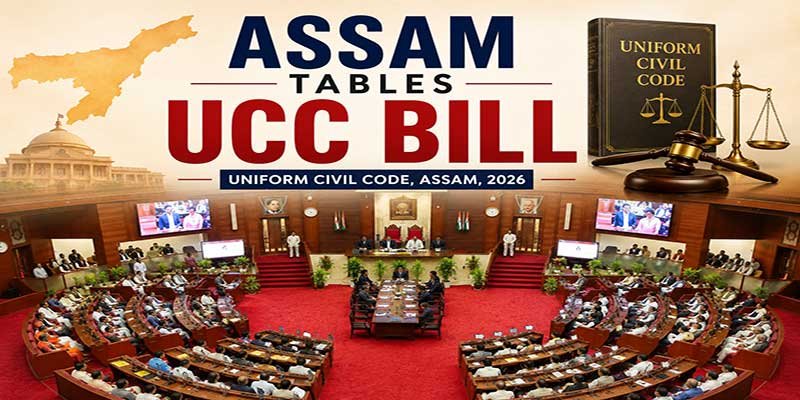
GUWAHATI — The Assam government officially tabled “The Uniform Civil Code, Assam, 2026 Bill” in the state Legislative Assembly on May 25, 2026. State Parliamentary Affairs Minister Atul Bora introduced the landmark legislation on behalf of Chief Minister Himanta Biswa Sarma.

The bill establishes a common civil legal framework governing marriage, divorce, succession, and live-in relationships for all residents across communities. If passed, Assam will become the third BJP-ruled state in India to implement a Uniform Civil Code (UCC), following Uttarakhand and Gujarat.
Key Legislative Provisions
The comprehensive draft legislation aims to replace religion-based personal laws with a unified civil structure focused on gender justice, legal transparency, and equal rights.


- Complete Ban on Polygamy: The bill enforces a strict legal mandate for monogamy across all religions. Any individual who enters a second marriage without legally dissolving their first union will face robust penalties, including up to seven years of imprisonment.
- Mandatory Registration Timelines: To guarantee legal security, all marriages and divorces must be formally recorded by submitting a memorandum to the Sub-Registrar within 60 days of the ceremony. Failure to do so will attract a ₹10,000 penalty.
- Strict Marriage Age Enforcement: The bill codifies the legal marriage age uniformly at 18 years for women and 21 years for men. The administration highlights this as an essential measure to permanently curb child marriages across the state.
- Regulation of Live-In Relationships: In a first for the state, live-in relationships are brought under a statutory regulatory framework. Partners must formally register their status within 30 days of cohabitation. This provision formally protects the legal rights, maintenance, and inheritance claims of both partners and any children born from the union.
- Equal Gender Succession: The legislation overhaul guarantees that daughters receive absolute parity in inheritance and property succession rights, removing historical disparities present in traditional personal laws.
Blanket Exemptions for Tribal Communities
To fully respect and preserve the distinct constitutional safeguards and indigenous rights within the region, the state government has embedded explicit exclusions into the draft:
- Scheduled Tribes: The entire scope of the UCC Bill will not apply to any of the Scheduled Tribes or Adivasi communities residing in Assam.
- Autonomous Regions: All tribal-administered territories covered under the Sixth Schedule of the Indian Constitution are entirely exempt from these laws to preserve their self-governance and customary protections.
- Religious Practices: Chief Minister Sarma explicitly clarified that the law only targets social and civil regulations. Core religious rituals, traditions, and faith-based wedding ceremonies (such as Christian, Sikh, or Muslim customary practices) remain completely unhindered.
Assembly Reactions and Next Steps
The introduction of the bill triggered intense immediate protests on the assembly floor. Major opposition parties, including the Indian National Congress, All India Trinamool Congress, and Raijor Dal, aggressively objected to the legislation’s tabling.
Opposition lawmakers cited a lack of legislative transparency and demanded that the government halt proceedings to hold wider, comprehensive stakeholder consultations with various social and cultural groups before putting it to a vote.
Despite the political friction, the ruling National Democratic Alliance (NDA) holds a comfortable majority in the house. The Speaker has scheduled the bill for formal parliamentary floor debate and a final vote on May 27, 2026.