
ICMR Study Finds Guwahati Schools Report Highest Adolescent Substance Use Risk Among Surveyed Regions
The multi-centre study, published in The Lancet Regional Health – Southeast Asia, analysed over 6,100 adolescents across six Indian regions and found substantial geographical differences in substance use risk, with selected schools in Guwahati recording the highest prevalence.
GUWAHATI: A multi-centre study supported by the Indian Council of Medical Research (ICMR) has revealed significant regional disparities in substance use risk among school-going adolescents across India, with selected schools in Guwahati reporting markedly higher levels than other surveyed regions.

The findings, published in The Lancet Regional Health – Southeast Asia on July 22, 2026, are based on baseline data collected from 6,168 adolescents aged 10–19 years studying in 108 schools across six districts—Gorakhpur (Uttar Pradesh), Guwahati (Assam), Nagpur (Maharashtra), Rajkot (Gujarat), Deoghar (Jharkhand), and Puducherry.
The research formed part of a secondary analysis of a larger cluster randomised trial evaluating a Community Based Peer-Led Intervention (CPLI). Researchers used the World Health Organization’s Alcohol, Smoking and Substance Involvement Screening Test (ASSIST) to assess substance use risk among participants.
Also Read- After Gen-Z, Now Gen-Alpha Stage Successful Protest in Fatehpur


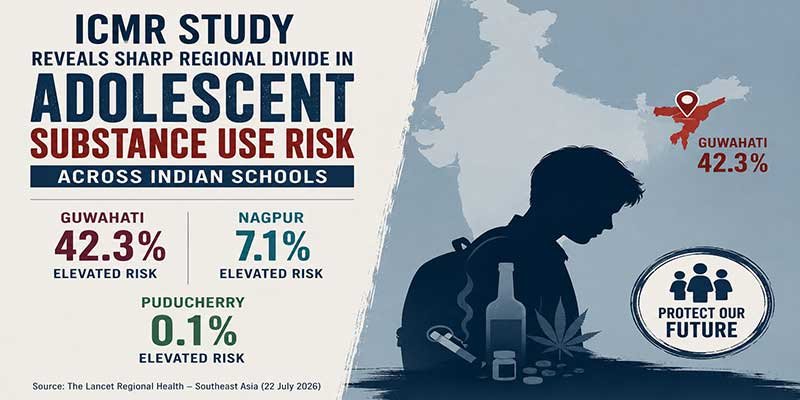
According to the study, 42.3 per cent of adolescents in the selected Guwahati schools fell into the combined moderate- and high-risk category for substance use. In comparison, the corresponding figure was 7.1 per cent in Nagpur and 0.1 per cent in Puducherry. Deoghar also recorded relatively higher levels of risk, indicating regional differences in adolescent vulnerability.
The researchers identified several factors associated with increased substance use risk, including easier accessibility to substances, greater digital media exposure, and favourable attitudes towards substance use. After adjusting for multiple variables, the analysis also found that male adolescents had lower odds of elevated substance use risk compared with females.
To better understand these regional differences, the research team employed multilevel statistical modelling and Fairlie decomposition analysis. While measurable factors such as school environment, socio-economic conditions, and personality traits explained approximately 38 per cent of the nearly 35-percentage-point difference between Guwahati and Nagpur, the remaining disparity suggests that broader contextual, social, and structural influences may also contribute significantly.
Also Read- Assam Flood Crisis Deepens; Death Toll Rises to 41, Over 9 Lakh Affected
The study notes that adolescent use of tobacco, alcohol, cannabis, inhalants, and pharmaceutical drugs is associated with long-term health and social consequences, including addiction, mental health disorders, poor academic performance, and school dropout.
The authors observed that although national programmes such as the School Health Programme under Ayushman Bharat have increased awareness, the findings indicate that broad national campaigns alone may not adequately address region-specific challenges. They recommend localised, multi-level interventions, expanded peer-led initiatives, stronger regulation of substance accessibility, and media literacy programmes to address the growing influence of digital platforms.
The research was led by U. Venkatesh and colleagues from participating AIIMS institutions and JIPMER Puducherry. The authors emphasised that the findings should be interpreted with caution, as the analysis relied on self-reported responses and data from selected schools rather than a nationally representative sample. They also called for further research to better understand the underlying causes of regional disparities.
Public health experts say the study contributes valuable evidence to the limited body of multi-site research on adolescent substance use in India and may help inform targeted interventions, particularly in regions where elevated risks have been identified.