
Assam Flood Crisis Deepens; Death Toll Rises to 41, Over 9 Lakh Affected
Heavy monsoon rains and a reported upstream cloudburst have triggered one of Assam's worst flood disasters in recent years, affecting more than nine lakh people across 25 districts as rescue and relief operations continue.
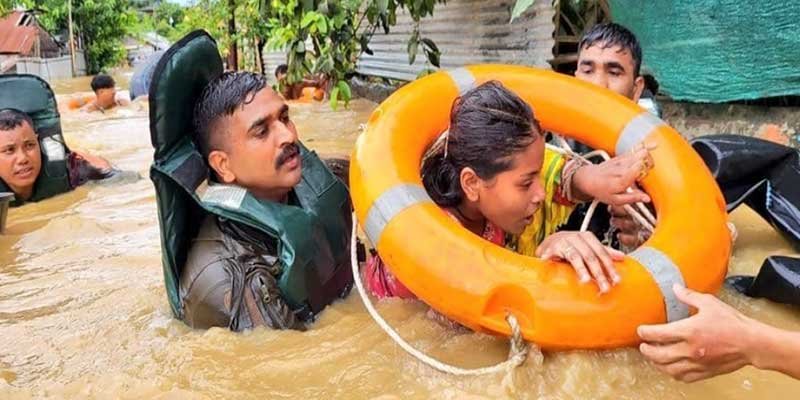
GUWAHATI- Assam is facing one of its most severe flood emergencies in recent years, with the death toll rising to 41 and more than nine lakh people affected across 25 districts, according to the latest bulletin issued by the Assam State Disaster Management Authority (ASDMA).

The flood situation has worsened following days of intense monsoon rainfall, compounded by a reported cloudburst in neighbouring Nagaland that led to a sudden surge of water into several river systems flowing through Upper Assam.
Official figures indicate that over 1,800 villages spread across 74 revenue circles are currently inundated. Among the worst-affected districts, Sivasagar has recorded the highest number of fatalities with 14 deaths, followed by Charaideo (6), Jorhat (5) and Golaghat.
Watch Video-


Authorities have also reported that more than 100 people remain missing, while rescue teams continue search operations in several inaccessible areas.
The floods have caused widespread destruction to agriculture and public infrastructure across the state.
According to ASDMA, more than 24,897 hectares of standing crops and paddy fields have been submerged, raising concerns over significant agricultural losses and the livelihoods of farming communities.
Housing has also suffered extensive damage, with 401 houses completely destroyed and 1,848 partially damaged, forcing thousands of residents to seek shelter in relief camps or on elevated ground.
Also Read- Assam Floods Affect Over 5.64 Lakh People; Death Toll Rises to 31
Floodwaters have disrupted transportation in several districts, submerging 33 major roads, including stretches of the Jorhat–Sivasagar National Highway. Multiple bridges have been washed away, including a key railway bridge in Dhemaji district, while six embankments have reportedly been breached, further aggravating flooding in low-lying areas.
A large-scale multi-agency rescue operation is underway involving the Indian Army, National Disaster Response Force (NDRF), State Disaster Response Force (SDRF), Fire and Emergency Services, district administrations and local police.
The state government has established 95 relief camps, currently sheltering approximately 18,574 displaced people, while 469 relief distribution centres are supplying food and other essential items to affected communities.
Also Read- Manipur: 46 KCP (PWG) Cadres Lay Down Arms Under Rehabilitation Initiative
During the last 24 hours, authorities distributed more than 5,011 quintals of rice, 956 quintals of pulses (dal) and over 20,000 litres of mustard oil as part of the ongoing relief effort. The Indian Air Force and the Army remain on standby for emergency airlift operations to reach inaccessible areas if required.
Chief Minister Himanta Biswa Sarma visited several flood-affected areas, including Sivasagar, Charaideo and Jorhat, to review rescue and relief operations. He inspected relief camps and interacted with displaced residents and local officials overseeing emergency response efforts.
During his visit, the Chief Minister described the floods as unprecedented for several Upper Assam districts, noting that the combination of excessive rainfall and upstream water inflow had caused flooding in areas that rarely experience such severe inundation.
Also Read- Congress Leaders Led by Rahul Gandhi Stage Dharna Outside PM’s Residence; Police Remove Them
He said all government agencies had been mobilised for rescue operations and announced that the families of those who lost their lives would receive ₹4 lakh as ex-gratia assistance. He also directed district administrations to intensify rescue operations and ensure that food, medicines and other essential supplies reach every affected household.
The India Meteorological Department (IMD) has maintained a Yellow Alert for Assam, warning of continued rainfall in isolated areas.
Major rivers, including the Brahmaputra, Dikhou, Desang and Dhansiri, continue to flow above danger levels, keeping authorities on high alert. Officials are closely monitoring river levels and weather conditions while urging residents in vulnerable areas to follow evacuation advisories and cooperate with emergency responders.
With rescue operations still ongoing and several areas remaining inaccessible, authorities say the full extent of the damage is yet to be assessed.