
Siang Dam “Will Be Built, Come What May,” Says Arunachal East MP Tapir Gao
Gao stated that 92 people had been arrested in connection with the Pasighat incidents, with more than 100 others still to be arrested.
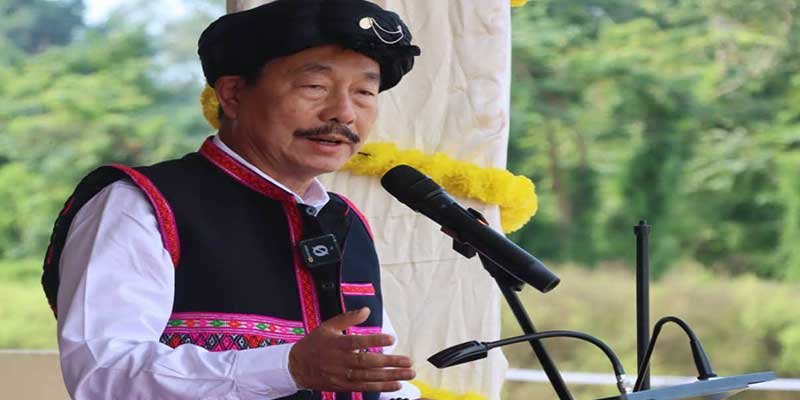
TEZU- Arunachal Pradesh Lok Sabha MP Tapir Gao (BJP) has taken a firm stand on the proposed Siang Upper Multipurpose Project (SUMP), declaring that the mega-dam “will be built, come what may.” Speaking at a meeting in Tezu, Lohit district—coinciding with events involving students of Indira Gandhi Government College—he accused anti-dam protesters of pursuing a politically motivated agitation and provided updated figures on the fallout from the October 23 violence in Pasighat.

Gao stated that 92 people had been arrested in connection with the Pasighat incidents, with more than 100 others still to be arrested. He linked the unrest to what he described as “Gen Z” protesters. The October 23 events followed a 12-hour bandh called by groups including the Adi Baane Kebang (United) and Siang Indigenous Farmers’ Forum (SIFF) affiliates; they escalated into arson and vandalism targeting the NHPC office, a police station, police vehicles, and residences of local MLAs and the state BJP president, leaving dozens of security personnel injured.
While acknowledging that the Centre, in coordination with the state leadership, is seeking a feasibility report before a final decision, Gao reiterated the project’s necessity for Arunachal Pradesh’s development and India’s strategic interests. He referred to an earlier speech in Riga (Siang district): “That is why I had said in a speech in Riga: ‘The dam will be built, come what may’. Even if it does not happen during our generation, even if we grow old and die, the Govt of India will eventually have to build at least one dam on the Brahmaputra and the Siang.” He noted that the project was declared a national project in 2008 under the then UPA government led by Manmohan Singh.


Contrast with State Leadership’s Position
Gao’s categorical assertion stands in contrast to the more measured stance repeatedly articulated by Chief Minister Pema Khandu and Deputy Chief Minister Chowna Mein. Both leaders have emphasised that no final decision on construction has been taken and that the current focus is solely on the Pre-Feasibility Report (PFR)—a preliminary technical assessment of site suitability, geology, hydrology, and potential impacts in the seismically active zone.
Khandu has stated on multiple occasions that the PFR does not equate to a decision to build the dam. “This dam is not going to be built. This is only for PFR. Based on the PFR report, it will be seen whether this dam will be built or not,” he said during interactions in the Siang region. He has assured that if experts conclude the project is not feasible, “there will be no further process,” and that any subsequent steps would require Social Impact Assessment, Environmental Impact Assessment, and extensive public consultation in line with legal provisions. He has invited stakeholders—including youth wings of Adi organisations and student unions—for dialogue, stating that the government would not force the project and that public consent remains essential.
Also Read- Manipur: Joint Forces Destroy 45 Acres of Illicit Poppy at Thangjing Hill Range
Deputy Chief Minister Chowna Mein, who holds the hydropower portfolio, has similarly invited opposing groups for roundtable talks and stressed unity of position with the Chief Minister. “There is no difference of opinion on this issue from my side. I stand with the people of Arunachal Pradesh… We will speak with one voice,” Mein said recently in Namsai. He challenged claims that the government has committed to construction, asking whether either he or the CM has ever announced that a dam would be built, and reiterated that the consistent message has been engagement with communities on the PFR. Mein has previously hosted community leaders and representatives of the Adi-Galo Welfare Society for discussions and called for a conducive atmosphere for dialogue.
Project Background and Ongoing Tensions
The proposed SUMP is an approximately 11,200 MW storage-type project (estimated cost around ₹1.13 lakh crore or higher in some assessments), with a potential dam height of 280–300 metres and live storage of about 9.2 billion cubic metres. Entrusted to NHPC, it is positioned by the Centre and state government as a strategic buffer against China’s ~60,000 MW Medog/Yarlung Tsangpo hydropower complex in Tibet, whose construction formally began in July 2025. Indian authorities view it as a means to regulate floods, secure lean-season flows, and mitigate risks from sudden upstream releases or water diversion—concerns Gao and others have long described as a potential “water bomb
Local Adi and Galo communities, however, oppose even the PFR stage, citing fears of submergence of ancestral lands (estimates suggest dozens of villages could be affected), displacement, loss of livelihoods tied to the Siang river (“Ane Siang”), cultural erosion, and ecological risks in a fragile Himalayan seismic zone. Groups such as SIFF have rejected recent invitations for talks from the Chief Minister’s office, conditioning dialogue on the release of detained protesters and withdrawal of security forces. Earlier reports indicated varying numbers of arrests (with police figures evolving amid multiple cases across Siang, Upper Siang, and East Siang districts) and deployment of additional Central Armed Police Forces
Also Read- NCB-Led Joint Operation Destroys More Than 1.37 Lakh Kg of Cannabis Plants
The divergence between Gao’s assertive “come what may” position and the state leadership’s insistence on completing the PFR first, followed by consultation, underscores the deep trust deficit surrounding the project. While the government frames the exercise as scientific assessment essential for national water and strategic security, protesters and some opposition voices (including the state Congress, which has criticised Gao for ignoring Adi concerns and questioned Union Minister Kiren Rijiju’s silence) argue that proceeding risks irreversible harm without genuine consent.
As surveys and the PFR process (projected to span a few months) continue amid heightened security, the gap between the MP’s long-term certainty and the CM-Dy CM emphasis on informed, consultative decision-making is likely to shape the next phase of the debate in the Siang valley.


