
Marriage Can Wait? AMCH Order Asking Medical Trainees to Defer Marriage Sparks Debate
An office order issued by the Department of Medicine on November 18 advises postgraduate trainees in General Medicine to postpone marriage and other personal milestones until completion of their residency, prompting questions about professional commitment and individual choice.
DIBRUGARH: For young doctors undergoing postgraduate medical training, life is often measured in hospital duty hours, emergency calls, academic sessions and sleepless nights. Their professional responsibilities frequently leave little time for family, relationships and personal milestones.

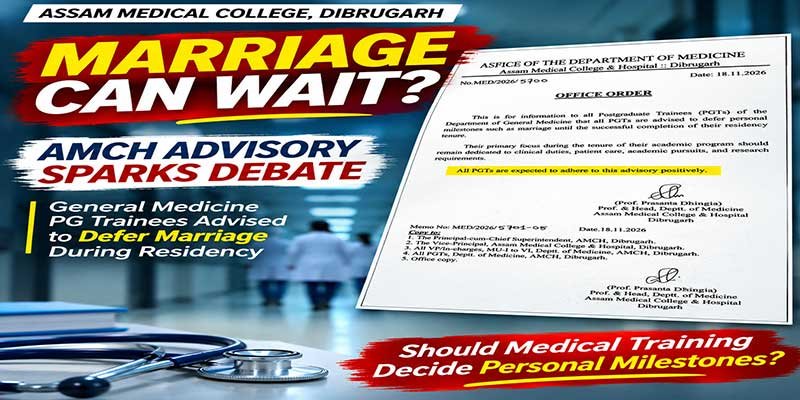
But an office order issued by the Department of Medicine at Assam Medical College and Hospital (AMCH), Dibrugarh, has brought an unusual question into the discussion: Should young doctors postpone marriage until they complete their three-year postgraduate residency?
Dated November 18, 2026, the order, issued by Prof. Prasanta Dhingia, Professor and Head of the Department of Medicine, is addressed to postgraduate trainees (PGTs) of the Department of General Medicine.


The order advises all trainees to defer personal milestones, specifically mentioning marriage, until the successful completion of their residency tenure.
It further states that their primary focus during the academic programme should remain dedicated to clinical duties, patient care, academic pursuits and research requirements.
However, one particular sentence in the order has drawn attention: “All PGTs are expected to adhere to this advisory positively.”
Although described as an advisory, the wording has raised questions about whether postponing marriage is being presented as a personal choice or an institutional expectation.
Also Read- Two Artists with Nepali Roots Draw Attention in Salman Khan’s Maatrubhumi
WHEN PROFESSIONAL COMMITMENT MEETS PERSONAL LIFE
Postgraduate residency is widely recognised as one of the most demanding phases of a doctor’s professional journey.
Long hospital shifts, emergency responsibilities, patient management, examinations and research often require considerable personal sacrifices. Many young doctors find themselves missing family gatherings, celebrations and important occasions because of their professional commitments.
For some, postponing marriage during this demanding period may be a personal decision. They may prefer to complete their training before taking on additional responsibilities.
But there is a difference between making that decision independently and being advised by an institution to do so.
Marriage is a significant personal milestone, influenced by individual circumstances, relationships and family considerations. The question raised by the AMCH order is whether professional dedication should extend to decisions that ordinarily belong to an individual’s private life.
WHY THE ISSUE MAY BE MORE SENSITIVE FOR WOMEN DOCTORS
The discussion also brings attention to the additional pressures often experienced by women pursuing demanding professional careers.
Questions surrounding marriage, maternity leave and continuity at work have long been part of the challenges faced by women in medicine.
Women doctors may already feel the need to demonstrate that personal responsibilities will not affect their professional performance. An institutional advisory recommending that marriage be deferred could add to those expectations.
The concern is not whether some doctors choose to postpone marriage, but whether those who make a different personal choice could be perceived as less committed to their profession.
FAIMA SEEKS WITHDRAWAL OF THE ADVISORY
The Federation of All India Medical Association (FAIMA) has called for the withdrawal of the advisory, arguing that medical institutions should concentrate on improving working conditions and regulating duty hours rather than influencing the private lives of postgraduate trainees.
The organisation’s position has brought the issue into a wider discussion about the working environment in medical colleges and the boundaries of institutional authority.
The office order itself does not cite any National Medical Commission regulation or university requirement mandating postponement of marriage during postgraduate residency.
A LARGER QUESTION BEYOND ONE OFFICE ORDER
The controversy is ultimately about finding a balance between professional responsibilities and individual freedom.
Medical institutions have every reason to expect discipline, commitment and dedication from their trainees. Patient care, academic performance and clinical competence must remain central to medical education.
But young doctors are also individuals with personal aspirations, families and relationships. Their commitment to patients does not mean that every other aspect of their lives must remain on hold.
The AMCH advisory has therefore raised a question that extends beyond Dibrugarh: How much of a young doctor’s personal life should an institution seek to regulate in the name of professional training?
The medical profession needs dedicated doctors. But those doctors also deserve the freedom to make important decisions about their own lives.
After all, the people caring for patients in hospital wards are human beings too.