Manipur CM Calls for Dialogue and Unity to Restore Peace at Jan Kalyan Shivir
Speaking at a Jan Kalyan Shivir in Imphal West, Chief Minister Yumnam Khemchand Singh stressed that peace and cooperation among communities are essential for Manipur's development while highlighting progress in railway connectivity and welfare delivery.
IMPHAL- Manipur Chief Minister Yumnam Khemchand Singh on Saturday called upon all communities in the state to embrace dialogue and cooperation to restore peace, asserting that sustainable development cannot be achieved without a peaceful environment.

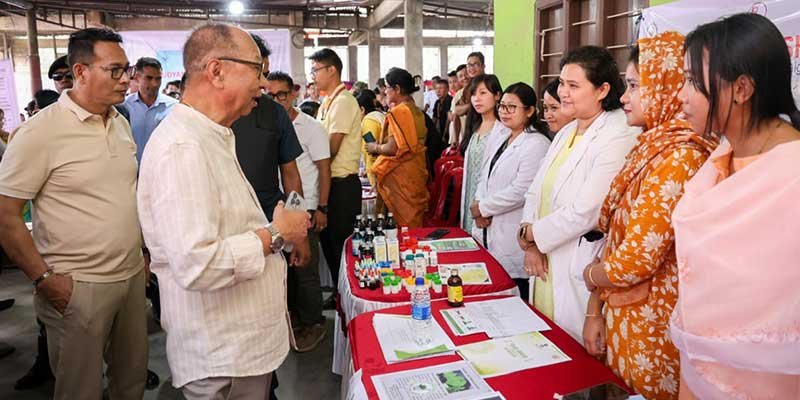
The Chief Minister made the remarks while attending the Jan Kalyan Shivir (Public Welfare Camp) organised by the District Administration, Imphal West, at Chingamathak Young Learners’ Club, Hao Ground, Chingamathak (Pishum Lampak) in Imphal.
Addressing the gathering, Singh said the welfare camp was aimed at ensuring the effective doorstep delivery of government welfare schemes and public services to citizens. He noted that such initiatives form part of the broader effort to achieve the vision of “Viksit Bharat–Viksit Manipur 2047” through improved governance and public outreach.
Also Read- MA Sociology Students Receive Answer Keys Instead of Question Papers

The Chief Minister also highlighted the role of Prime Minister Narendra Modi’s leadership in advancing developmental initiatives across the country and said the welfare camps are intended to strengthen access to government services at the grassroots level.
Touching upon infrastructure development, Singh provided an update on ongoing railway projects in Manipur. He informed that the railway line has already reached Khongsang and is expected to be extended to Imphal within the next two years. He further stated that the rail network is planned to be expanded up to Moreh, a key border town along the India-Myanmar frontier.
Also Read- Development Is the Most Effective Tool Against Insurgency: Manipur CM Tells NITI Aayog
According to the Chief Minister, enhanced railway connectivity is expected to boost trade, improve mobility and support economic development in the region. He also referred to India’s Act East Policy, saying it would position Manipur as a gateway to Southeast Asia and create new opportunities for future generations.
Emphasising the importance of social harmony, Singh said development efforts would remain incomplete without peace and stability. He urged all communities in Manipur to set aside differences and engage in dialogue to resolve issues amicably.
Also Read- Two Killed, Houses Burnt in Fresh Violence in Kamjong Dist
“There will be no development without peace,” the Chief Minister said, appealing to citizens to support the government’s ongoing efforts to restore normalcy and strengthen communal harmony across the state.
During the programme, Singh distributed educational allowances to two children with special needs through the Education Department, Imphal West. He also handed over nutritious food packets containing essential dietary items to four tuberculosis patients as part of government welfare initiatives.
The Chief Minister later visited exhibition stalls set up by various state government departments showcasing beneficiary-oriented schemes and public welfare programmes available to citizens.
Also Read- Manipur CM Highlights Peace Efforts, Seeks Greater Central Support at NITI Aayog Meeting
The event was attended by the Deputy Commissioner of Imphal West, the Director of Planning, the Mayor of Imphal Municipal Corporation, officials from various government departments and local residents.
Earlier in the day, Singh attended the 7th Governor’s Art Award ceremony held at the Cabinet Hall of the Chief Minister’s Secretariat in Mantripukhri, Imphal. During the event, noted artist Yendrembam Ibochouba Singh was honoured for his significant contributions to the field of fine arts.
Observers note that the Chief Minister’s emphasis on peace, connectivity and welfare delivery reflects the government’s broader strategy of linking development initiatives with efforts to restore stability and strengthen public confidence in state institutions.